Last Updated: November 16, 2026
Quick Summary
Preventing foundation issues in older properties means keeping soil moisture steady, grading soil to slope away from the house, and extending downspouts so water exits several feet from the foundation. Inspect twice a year and after heavy rainfall, and document any crack with a dated photo so you can tell whether it is active.
- Clay soil expands after heavy rainfall and contracts in dry seasons, shifting the foundation with it.
- Mark a crack and check it again in 30 days to see whether it is growing.
- Clean gutters at least twice a year, more if trees hang over the roof.
- Pre-1950 homes should be inspected twice a year and after any heavy rainfall.
- Sealing a crack before documenting whether it is active can hide the evidence.
Table of Contents
- Why Older Properties Face Foundation Issues
- Foundation Settling vs. Foundation Problems: How to Tell the Difference
- Signs of Foundation Problems You Should Never Ignore
- Foundation Drainage and Grading: The First Line of Defense
- Managing Gutters, Downspouts, and Surface Water
- Landscaping, Tree Roots, and Soil Moisture Control
- Your Foundation Inspection Checklist for Older Homes
- Schedule a Professional Foundation Inspection
- Frequently Asked Questions
Why Older Properties Face Foundation Issues
Preventing foundation issues in older properties starts with understanding why they happen. Older homes were often built on shallow footings, with clay soil that swells when wet and shrinks when dry.
The damage rarely appears overnight. It builds through small, repeated soil movement.
Three forces drive most problems in aging homes:
- Soil movement: Clay soil expands after heavy rainfall, then contracts in dry seasons. The foundation shifts with it.
- Water intrusion: Poor drainage lets surface water pool against foundation walls. That water finds cracks and weakens the structure.
- Settling: Older footings were not always poured to modern standards. Settlement is common, and it worsens over time.
The good news is that most of this is manageable with a steady maintenance plan. The bad news is that neglect speeds up foundation damage fast.
Foundation Settling vs. Foundation Problems: How to Tell the Difference
Foundation settling is normal, minor movement as soil compacts under a home. Foundation problems are ongoing movement that damages the structure. The first is often cosmetic. The second needs repair.
Hairline cracks in a slab or a slightly uneven door can be settling. For a closer look at how to fix minor basement cracks, our guide on repairing small basement foundation cracks walks through each step.
The distinction matters because prevention and repair are different budgets and different timelines. A triage framework keeps you from overreacting to cosmetic movement and from underreacting to active structural movement. Findings are commonly sorted into three buckets:
- Monitor: Hairline cracks, minor floor slope, or a single sticking door that has not changed in months. Document and recheck on a schedule.
- Investigate: A crack that has widened, a floor that slopes more than about an inch over 20 feet, or doors that stick in one spot. These warrant a professional foundation inspection before the next wet season.
- Act now: Bowing or leaning walls, stair-step cracks in brick or block, gaps where walls meet ceilings or floors, or water entering a crawlspace. These point to active movement and should be assessed by a licensed engineer or foundation specialist promptly.
Here is a practical test to use. Ask three questions:
- Is the crack growing? Mark it and check again in 30 days.
- Is the floor uneven, or do doors stick in one spot?
- Does water pool near the foundation after rain?
How prevention differs by foundation type
The triage above is general. What counts as normal movement depends on how the house was built:
- Slab-on-grade: Hairline shrinkage cracks are common and often benign. Cracks that run diagonally from a corner, or that show vertical displacement on either side, are the ones to flag.
- Pier-and-beam and crawlspace: Look for sagging floors, pier settlement, and moisture in the crawlspace. Releveling is possible, but repeated shimming without fixing the moisture source is a temporary fix.
- Basement: Bowing or block walls that lean inward are a structural warning. Horizontal cracks near the middle of a wall often indicate soil pressure, not settling.
- Stone and brick historic foundations: Mortar joints are the sacrificial layer. Repointing with modern hard mortar can trap moisture and spall the original masonry, so compatible materials matter more than speed.
Measuring movement instead of guessing
Eyeballing a crack is unreliable. A simple monitoring routine gives you evidence:
- Photograph each crack with a ruler or coin for scale, and write the date on a card in the frame.
- Use a crack gauge or a pencil mark at each end to see whether it lengthens.
- Record floor slope with a 4-foot level and a tape measure at the same spots each time.
- Note door and window fit in the same season each year, since wood swells and sticks in humid months.
Watch out: sealing a crack before you have documented whether it is active can hide the evidence. Mark first, then repair.
Signs of Foundation Problems You Should Never Ignore
Common signs of foundation problems include structural warning signs such as:
- Stair-step cracks in brick or block foundation walls
- Bowing walls that lean inward, often in a basement
- Doors and windows that stick or no longer latch
- Uneven floors that slope toward one side
- Gaps where walls meet the ceiling or floor
Inspectors tend to flag specific problems first. Our breakdown of the foundation problems home inspectors identify first shows what usually tops the list.
A common mistake is painting over a crack and calling it fixed. That hides the symptom and lets the cause keep working. Watch out: covering a widening crack with sealant can mask active movement until real structural damage sets in.
Foundation Drainage and Grading: The First Line of Defense
Proper grading is often one of the most cost-effective ways to protect a foundation.
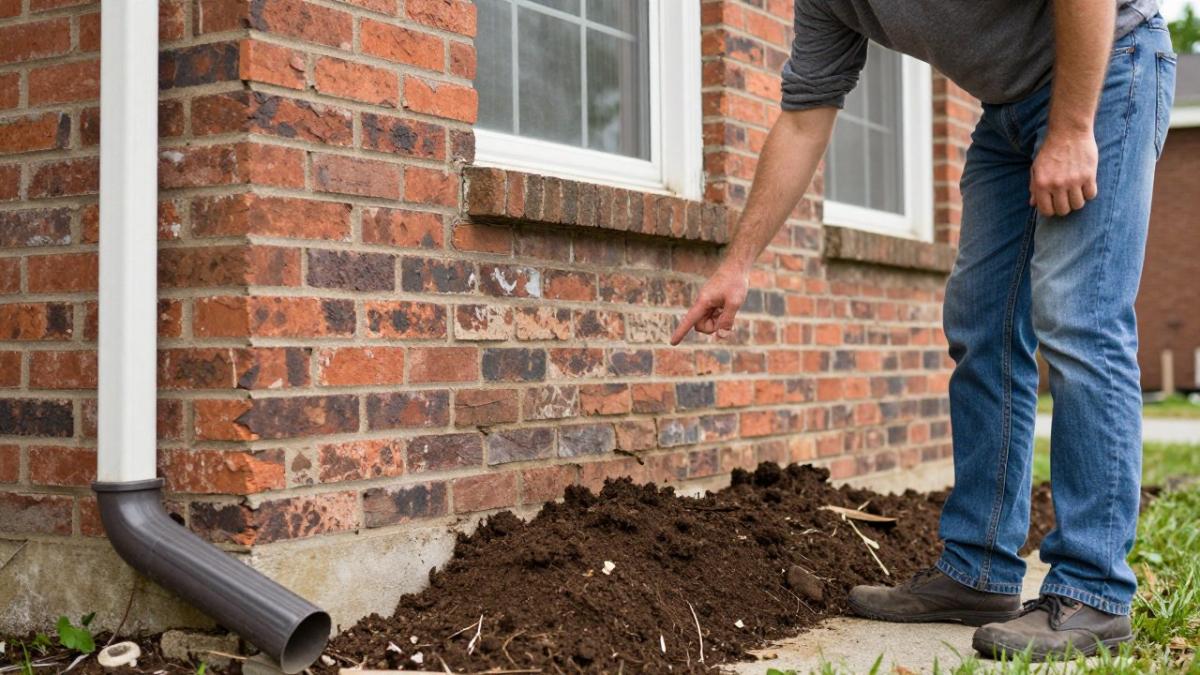
The ground should slope away from the foundation at a steady fall. Where soil has settled and now slopes back toward the house, surface water runs straight to the walls.
For homes with chronic wet basements, a French drain or sump pump can move water away from the structure. Basement waterproofing adds another layer of protection. The U.S.
Managing Gutters, Downspouts, and Surface Water
Clogged gutters are the most overlooked cause of foundation damage. When gutters fill with leaves, water spills over the edge and lands right at the foundation. Downspouts that dump water within a few feet of the wall do the same thing.
Keep this system working with a simple routine:
- Clean gutters at least twice a year, more if trees hang over the roof
- Extend downspouts so water exits several feet from the foundation
- Check that water flows away from the house, not into a low spot
- Clear debris from window wells and crawlspace vents
A single heavy rainfall can send a large volume of surface water against a foundation wall in minutes. Routine gutter maintenance helps reduce that risk of water intrusion.
Landscaping, Tree Roots, and Soil Moisture Control
Tree roots and soil moisture both push soil around, and both affect foundation movement. Roots from trees planted close to the house can dry out soil under a footing. Large trees also draw moisture from expansive clay, which makes the soil shrink and settle.
Landscaping choices matter more than most owners realize:
- Plant large trees well away from the foundation
- Keep soil moisture steady with mulch and targeted watering in dry seasons
- Avoid piling soil or mulch too high against siding and foundation walls
- Watch for roots that have lifted a walkway or patio near the house
Moisture levels should stay as even as possible through wet and dry seasons.
Your Foundation Inspection Checklist for Older Homes
A foundation inspection checklist helps you catch small problems before they become repairs. But older properties need more than a generic walkthrough.
Age-based maintenance schedule
- Pre-1950 homes: Inspect twice a year and after any heavy rainfall. Older footings were often shallow and unreinforced, and original drainage may have failed decades ago. Prioritize grading, downspout extensions, and mortar condition on masonry foundations.
- 1950-1980 homes: Inspect twice a year. This era saw a mix of slab and crawlspace construction, and many homes now have mature trees whose roots have had decades to affect soil moisture. Watch for root heave near walkways and patios.
- 1980-2000 homes: Inspect annually plus after major weather events. Builder-grade drainage and gutters are often at the end of their service life, so check that downspouts still discharge well away from the wall.
- Any home with a history of repairs: Inspect on the schedule your engineer or foundation contractor recommends, and keep the prior reports with your documentation so changes are measured against a baseline.
Seasonal checklist
Run this walkthrough on the schedule above, and after any season of heavy rainfall.
- Walk the exterior and note any new cracks in the foundation walls
- Check that soil slopes away from the house on all sides
- Confirm downspouts carry water well away from the foundation
- Look for stair-step cracks in brick or block
- Test interior doors and windows for sticking or gaps
Foundation-type additions
Add these items depending on construction:
- Slab: Note diagonal corner cracks and any vertical displacement at the crack edges.
- Crawlspace: Check vapor barrier condition, standing water, and pier shims.
- Basement: Look for horizontal wall cracks and efflorescence, which signals moisture moving through masonry.
- Stone or brick historic foundation: Inspect mortar joints for crumbling or recessed mortar, and note any spalling brick or stone.
Turning findings into action
A checklist is only useful if it drives a decision. Sort each finding into monitor, investigate, or act now using the triage in the previous section.
Some problems hide behind finished walls and under floors. Our article on the benefits of thermal imaging home inspection explains what that tool can uncover.
Watch out: a checklist completed from memory is not documentation.
How often to inspect depends on when your home was built.
| Home era | Inspection frequency | What to watch |
|---|---|---|
| Pre-1950 homes | Twice a year and after heavy rainfall | Shallow unreinforced footings, failed drainage, mortar condition |
| 1950-1980 homes | Twice a year | Mature tree roots, root heave near walkways and patios |
| 1980-2000 homes | Annually plus after major weather events | Builder-grade drainage and gutters at end of service life |
| Any home with a history of repairs | Schedule recommended by engineer or foundation contractor | Keep prior reports to measure changes against a baseline |
Schedule a Professional Foundation Inspection
A professional foundation inspection is the step that turns guesswork into a clear plan.
We built our service around that clarity. Full Disclosure Property Inspection is led by Certified Master Inspector Melanie Crabtree, who brings a general contracting and land development background to every inspection.
If an inspection turns up foundation issues, you are not left guessing what to do next. Our guide on handling foundation issues found during inspection lays out the next steps, and buyers weighing an older home can review identifying foundation issues before buying first.
The right time to inspect is before small cracks become structural damage.
Older properties reward owners who stay ahead of water, soil, and time.
Frequently Asked Questions
How often should an older home’s foundation be inspected?
Most older homes benefit from a foundation inspection checklist walkthrough once a year, ideally in spring after the wet season and again in fall before winter. A professional foundation inspection every three to five years catches slow settlement and drainage problems before they turn into structural damage. Homes with a known history of foundation movement, expansive clay soil, or previous repairs should be checked more often. Early intervention is almost always cheaper than foundation repair and stabilization.
How does poor drainage affect an older home’s foundation?
Poor drainage lets surface water pool against foundation walls, where it saturates the soil and increases water intrusion and hydrostatic pressure. In expansive clay soil, that moisture causes the ground to swell and shrink through wet and dry seasons, which drives foundation movement and settlement. Correcting foundation drainage and grading, cleaning gutters, and extending downspouts several feet from the house are the most effective preventive maintenance steps for older properties.
What are the early warning signs of foundation problems?
Watch for stair-step cracks in brick or block, diagonal cracks at window and door corners, doors and windows that stick, uneven or sloping floors, and gaps around exterior trim. Bowing walls, cracks wider than a quarter inch, and cracks that keep growing point to active foundation movement. Hairline cracks in drywall are often cosmetic, but any crack that changes size or lets daylight through deserves a professional evaluation before you buy or sell.
When should I call a structural engineer about foundation cracks?
Call a structural engineer when a crack is wider than a quarter inch, runs diagonally or in a stair-step pattern, appears alongside bowing walls or sloping floors, or keeps widening after repair. A certified home inspector can document the signs of foundation problems and flag what needs a specialist’s review. Getting an independent opinion early lets you compare foundation repair options, permits, and documentation before costs climb.


