Table of Contents
- What Thermal Imaging Actually Reveals in a Home
- Detecting Moisture with Thermal Imaging
- Electrical Hot Spots Home Inspection
- Finding Insulation Gaps and Energy Loss
- Infrared Home Inspection Cost: Is It Worth It?
- Limitations of Thermal Imaging
- Conclusion
- Frequently Asked Questions
Last Updated: September 16, 2026
What Thermal Imaging Actually Reveals in a Home
Infrared thermography is the practice of using a calibrated camera to read surface temperature differences and translate them into a visual map of a home’s hidden problems. At Full Disclosure Property Inspection, we use thermal imaging on every fee-paid inspection because it exposes what a visual walkthrough physically cannot: moisture behind drywall, missing insulation inside a wall cavity, and overheating electrical components. A standard inspection sees surfaces. Thermal imaging sees behavior.
How Infrared Thermography Works
Every object emits infrared radiation in proportion to its temperature. A thermal camera’s infrared sensor detects that radiation and converts it into a color-coded image, where cooler areas typically appear blue or purple and warmer areas appear orange or red. The camera does not see through walls. It reads surface temperature, and a trained inspector interprets what those temperature differences mean.
That interpretation is the entire skill. A cold patch on a ceiling could be a roof leak, a missing insulation batt, or normal thermal bridging at a rafter. The camera shows the thermal signature; the inspector explains the cause.
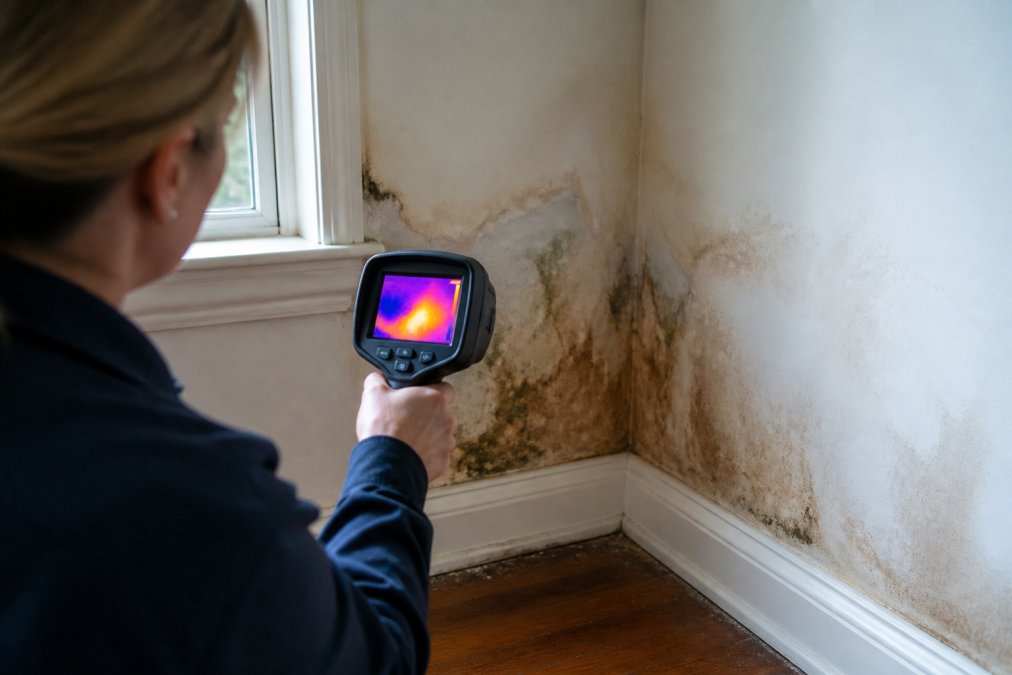
Detecting Moisture with Thermal Imaging
Detecting moisture with thermal imaging works because wet building materials hold and release heat differently than dry ones. When water intrudes behind drywall or under a subfloor, that area changes temperature at a different rate than the surrounding material, creating a visible temperature differential the camera can catch.
The practical value is timing. Water damage rarely announces itself. It shows up as a stain months later, or as a soft spot in a floor, or as mold growth behind a baseboard. A non-invasive inspection with a thermal camera can flag moisture intrusion while it is still invisible to the eye, which gives a buyer use before closing rather than a repair bill after.
Water Damage and Mold Growth
Mold needs moisture, and moisture almost always starts somewhere specific. Thermal imaging helps trace a leak back to its source instead of just documenting the symptom. An inspector might find a warm band along a ceiling that points to a failed flashing detail on the roof, or a cold streak on a wall that traces to a failing supply line.
Never treat a thermal image as proof of moisture on its own. A camera can flag a suspicious temperature pattern, but confirming moisture intrusion requires a moisture meter reading. Any inspector who diagnoses a leak from a thermal image alone is skipping a step.
Electrical Hot Spots Home Inspection
Electrical hot spots home inspection is one of the strongest arguments for thermal imaging, because heat is the first warning sign of an electrical problem. The mechanism is simple physics: every connection has some resistance, and when a termination loosens, corrodes, or is backstabbed rather than screwed down, resistance at that point rises. Heat generated at a connection rises with the square of the current, so a marginal connection that feels fine at low draw can run dramatically hotter once a heavy load is applied. Loose connections, overloaded circuits, and failing breakers therefore generate heat long before they generate smoke.
Under normal load, a thermal camera can reveal a breaker or wire that is running noticeably warmer than its neighbors. This matters most in older homes where wiring has been added to over decades, a finished basement circuit tapped off an existing run, a range receptacle swapped without upgrading the conductor, aluminum branch wiring with a history of termination problems. A homeowner may never notice a warm outlet cover. A thermal scan under load will.
Circuit Breaker Load and Safety Hazards
The scan itself is straightforward. The inspector turns on major appliances and systems to put the panel under real load, then reads the temperature of each breaker and connection. A breaker that runs hot under normal load is a safety hazard worth investigating by a licensed electrician, even if it has never tripped.
Interpretation is where the skill lives. A warm breaker is not automatically a defect. Some breakers run warmer than others by design, tandem breakers carry more current in the same slot, and a circuit that is legitimately near its rating will be warmer than an idle one. What matters is the pattern: one breaker running 20°F to 30°F hotter than identical breakers carrying similar loads is a red flag, and a hot spot concentrated at the wire termination rather than the breaker body points to a loose connection rather than an overloaded circuit. The inspector compares like to like, notes the load at the time of the scan, and reports the differential rather than a raw temperature.
Ask your inspector to run the scan with the house under load, not at rest. A panel that looks perfectly normal with everything switched off can show clear electrical hot spots once the HVAC, dryer, and range are running.
Why Catching It Early Pays
This is the clearest place where a thermal scan earns its keep. A loose neutral at a receptacle or a failing breaker termination is a repair measured in a service call and a replacement device. Left alone, the same connection can progress to arcing, which is the ignition source behind a large share of residential electrical fires. The remediation math is not close: an electrician tightening or replacing a termination versus fire damage, smoke remediation, and an insurance claim.
For a buyer, a documented hot spot is also negotiating leverage. It is a specific, photographable finding tied to a specific circuit, which is far easier to price into a repair request than a vague note that the panel “should be evaluated.” For a seller, addressing it before listing removes an item that would otherwise surface during the buyer’s inspection and stall the transaction.
Schedule an Inspection or Request a Proposal →
Finding Insulation Gaps and Energy Loss
Finding insulation gaps and energy loss comes down to one principle: missing insulation creates a temperature difference you can see. Insulation voids, air infiltration around windows and doors, and HVAC duct leakage all show up as distinct thermal patterns. On an exterior wall in winter, a cold stripe where insulation should be is a direct visual of heat loss.
This is where thermal imaging pays for itself twice. First, it identifies problems the buyer can negotiate over. Second, it gives the new owner a prioritized list for improving energy efficiency, often starting with the cheapest fixes: sealing air infiltration around penetrations before adding insulation.
| Problem | Thermal Signature | What It Usually Means |
|---|---|---|
| Moisture intrusion | Irregular cool patch that persists | Active or past leak, needs meter confirmation |
| Missing insulation | Uniform cold or warm band in wall | Insulation void or settled batt |
| Electrical hot spot | Localized heat at breaker or outlet | Loose connection or overloaded circuit |
| Air infiltration | Thin cold lines at seams and frames | Failed weatherstripping or sealant |
| Duct leakage | Warm or cool streak near duct runs | Disconnected or torn duct |
Infrared Home Inspection Cost: Is It Worth It?
Infrared home inspection cost is the question that stops most buyers, and the honest answer is that thermal imaging is rarely a separate line item worth agonizing over. Many inspectors fold it into the standard inspection fee, and at Full Disclosure Property Inspection, infrared thermal imaging is included free with every fee-paid inspection. That changes the math entirely.
Even where it carries an added charge, weigh it against a single missed problem. A hidden roof leak that reaches the ceiling can mean drywall replacement, insulation replacement, mold remediation, and a repaint. A thermal scan that catches the same leak at the flashing stage costs a fraction of that. For sellers, the same scan identifies issues before listing, which supports a cleaner disclosure and fewer surprises at the negotiating table.
InterNACHI standards of practice for thermal imaging
Limitations of Thermal Imaging
Thermal imaging has real limits, and any inspector who oversells it is doing you a disservice. The camera reads surface temperature, so it cannot see through a wall, a floor, or a finished ceiling. It also depends heavily on conditions, and understanding those conditions is what separates a useful scan from a colorful picture.
The Delta T requirement. Thermal imaging finds problems by finding temperature differences, and the size of that difference is called Delta T, the spread between the temperature of the anomaly and its surroundings.
Thermal imaging is a diagnostic aid, not a verdict. It points to where a problem likely exists. Confirming that problem still requires a moisture meter, a circuit tester, or a specialist’s eyes.
Conclusion
The gap between what a visual inspection sees and what is actually happening inside a home’s walls is where expensive surprises live. Thermal imaging closes part of that gap by turning invisible temperature differences into actionable findings, and it does so without cutting, drilling, or damaging anything.
Frequently Asked Questions
Is thermal imaging worth it for a home inspection?
Thermal imaging is worth it for most homebuyers. It can detect hidden moisture intrusion, electrical hot spots, and insulation voids that a visual inspection misses. Finding one major issue, like a hidden leak that could cause mold growth, can save thousands in repairs. Many inspectors now include it as a standard part of the service.
What are the downsides of thermal imaging?
Thermal imaging has limitations. It cannot see through walls, and it requires a temperature differential to work well. On a mild day, hidden defects may not show up. It also needs a calibrated camera and a trained inspector to interpret thermal signatures accurately. It is a tool, not a magic solution.
Can thermal imaging detect mold behind walls?
Thermal imaging cannot detect mold directly, but it can find the moisture intrusion that leads to mold growth. The camera shows temperature differences caused by water. Once a wet area is found, the inspector can confirm with a moisture meter. Catching the moisture early prevents mold from developing.
How does thermal imaging differ from a standard visual home inspection?
A standard visual inspection relies on what the inspector can see. Thermal imaging adds a non-invasive layer by reading surface temperatures. It reveals hidden defects like water damage, missing insulation, and overheating circuits. Together, they provide a fuller picture of the home’s condition.


