Quick Summary
Hidden roof leaks can be found by using infrared thermography, which measures surface temperature to show damp insulation as cooler patterns. Scan after a sunny day and a cooling period, then confirm suspicious spots with a moisture meter in the attic.
- Scan in early evening or just before dawn, after a few hours of sun followed by cooling.
- Avoid scanning right after heavy rain, since uniform surface temperatures muddy the readings.
- Compare each cool spot against nearby dry areas and save a labeled image of every suspicious area.
- Confirm any cool patch in the attic with a moisture meter before calling it a leak.
- Infrared is a practical first step for homes because it is fast and needs no radioactive materials.
Table of Contents
- Why Hidden Roof Leaks Are So Hard to Find
- How Infrared Thermography Detects Moisture in Roofing
- Equipment You Need for an Infrared Roof Inspection
- Step-by-Step: Performing an Infrared Roof Scan
- Common Signs of a Hidden Roof Leak
- Reading Infrared Images to Pinpoint the Leak
- Infrared Versus Nuclear Roof Moisture Surveys
- Booking Your Infrared Roof Inspection in Chattanooga
- Frequently Asked Questions
How to Find Hidden Roof Leaks With Infrared
Last Updated: October 29, 2026
Why Hidden Roof Leaks Are So Hard to Find
Hidden roof leaks are one of the most expensive surprises in a home. Water can soak into insulation and framing long before a stain shows up on a ceiling. By then, the damage is already spreading.
This guide explains how infrared thermography can help locate moisture that the eye cannot see.
Water moves sideways, down and along rafters. A leak near a valley can show up feet away from where it enters the roof. That is why a visual check alone often misses the source.
Watch out: Do not assume a dry ceiling means a dry roof. Water can sit in insulation for months before it marks the drywall.
How Infrared Thermography Detects Moisture in Roofing
Infrared thermography measures surface temperature. Wet materials hold heat differently than dry ones, so they show up as distinct patterns on a thermal camera.
Thermography works best when the temperature difference is clear. Damp insulation often looks cooler than dry areas during the evening, after the sun has warmed the roof during the day.
Thermal images show where moisture may be present. See how thermal imaging inspections are performed and what they reveal. They do not prove the exact entry point on their own, so a follow-up visual check is still needed.
Equipment You Need for an Infrared Roof Inspection
A basic setup includes a thermal camera, a moisture meter for confirmation, a flashlight, and a ladder that meets safety rules.
- Thermal imaging camera with adjustable temperature range
- Moisture meter to confirm readings on accessible surfaces
- Flashlight and a notepad or phone for labeling images
- Ladder and fall protection gear for safe roof access
- Weather log showing recent rain, temperature, and wind
Prices for professional equipment vary by model and features, so check current manufacturer listings before buying.
The core kit for an infrared roof inspection is summarised below.
| Item | Purpose | Note |
|---|---|---|
| Thermal imaging camera | Detects surface temperature differences | Adjustable temperature range |
| Moisture meter | Confirms readings on accessible surfaces | Use to verify suspected leaks |
| Flashlight and notepad or phone | Lighting and labeling images | Label each saved image |
| Ladder and fall protection | Safe roof access | Must meet safety rules |
| Weather log | Records rain, temperature, wind | Gives readings context |
Step-by-Step: Performing an Infrared Roof Scan
A thorough scan follows a set order. Start with the right conditions, then move across the roof in a consistent pattern.
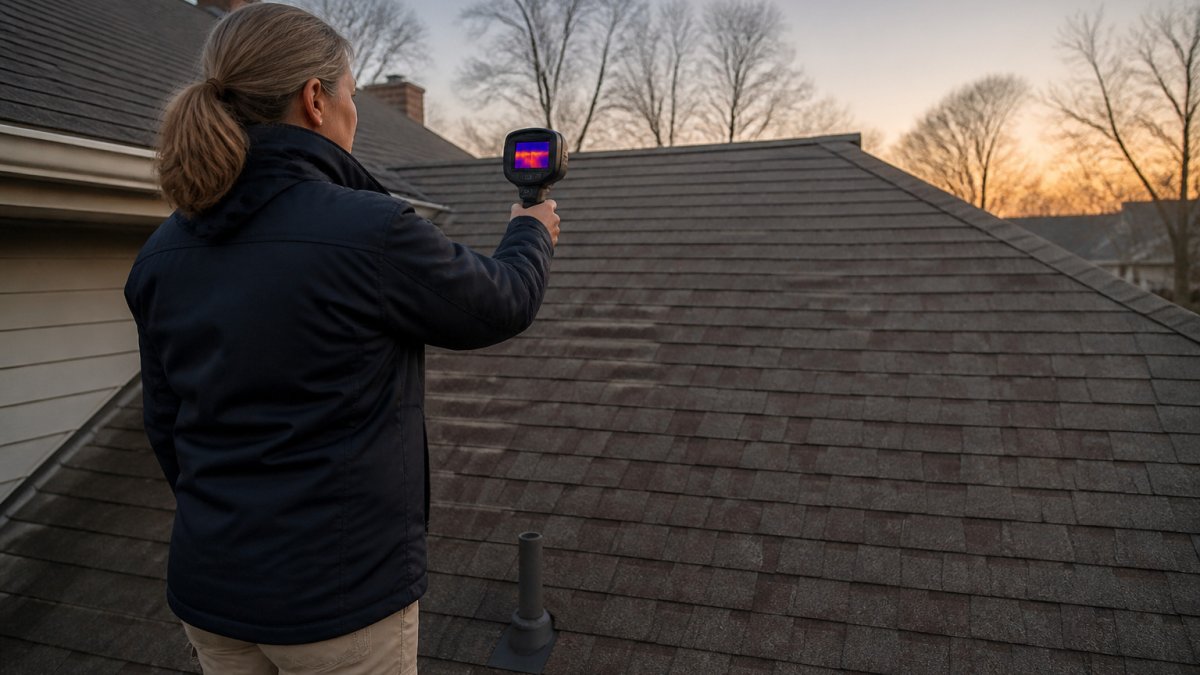
Choosing the Right Conditions and Timing
Scan after a few hours of sun followed by a cooling period. Temperature differences are clearest in the early evening or just before dawn.
Avoid scanning right after heavy rain, when surface temperatures are uniform and readings get muddied. Note recent weather in your report so the readings have context.
Schedule an Inspection or Request a Proposal →
Scanning the Roof Systematically
Work in a grid, one section at a time. Keep the camera steady and scan at a consistent distance so the temperature scale stays comparable across sections.
- Start at the lowest roof edge and work upward
- Scan each valley, penetration, and flashing joint
- Save an image of every suspicious area with a label
- Compare each cool spot against nearby dry areas
Pro tip: Always check the attic. Confirm any cool patch in the attic with a moisture meter before calling it a leak.
Common Signs of a Hidden Roof Leak
Some warning signs point to a leak even when the roof looks fine from the ground.
- Stains or soft spots on ceilings near exterior walls can also signal problems in the framing, so see what structural damage looks like in older houses.
- Peeling paint or bubbling drywall in upper rooms
- Musty smells in the attic or top floor
- Dark streaks or water marks on attic rafters
- Damp insulation that feels compressed or heavy
A common mistake is treating a single stain as the only evidence. Water often travels, so the leak may be several feet from the visible mark.
Reading Infrared Images to Pinpoint the Leak
Look for cool patterns that stand out from the surrounding area. A consistent cool zone that matches a roof feature, such as a valley or vent, is a strong lead. Know what a full roof inspection covers before you decide what to check or book.
Compare images taken from different angles. If a cool patch appears in both, the moisture is more likely real. A single odd reading may come from sun angle or a shaded area.
Confirm every lead before calling it a leak. Use a moisture meter in the attic and a visual check of the flashing and shingles at the same spot.
Infrared Versus Nuclear Roof Moisture Surveys
Infrared thermography is non-invasive and quick. A nuclear moisture survey uses a radioactive source to measure moisture beneath roofing layers and is typically used on large commercial roofs.
For most homes, infrared is the practical first step. It is faster, requires no radioactive materials, and avoids the licensing and handling rules that nuclear methods involve.
Booking Your Infrared Roof Inspection in Chattanooga
If you suspect a hidden roof leak, a professional inspection can show you what needs attention. Full Disclosure Property Inspection, led by Certified Master Inspector Melanie Crabtree, includes infrared thermal imaging at no extra charge with fee-paid home inspections.
Our reports are computer-generated and highlight critical areas. Our opinion is independent and protected by a strict Code of Ethics. Schedule an inspection or request a proposal.
Frequently Asked Questions
How does infrared imaging detect hidden roof leaks?
Infrared cameras read surface temperature rather than seeing through materials. Wet insulation and damp roof decking hold heat differently from dry areas, so they show up as cooler or warmer patches on the thermal image. The camera does not show the water itself. Because moisture often moves sideways or downhill before it appears inside, the thermal pattern can sit some distance from the actual entry point.
Can an infrared camera find every roof leak?
No. Infrared works best when there is a clear temperature difference between wet and dry materials, which usually means scanning during the right weather and time of day. It can miss leaks that have dried out, leaks where water has not yet soaked the insulation, and some flashing failures. Infrared is a screening tool that narrows where to look.
When should you hire a professional for an infrared roof inspection?
Hire a professional when you are buying or selling a home, after storm damage, or when you see unexplained staining, musty odors or rising utility bills tied to moisture.
What is the difference between infrared and nuclear roof moisture surveys?
Infrared surveys measure surface temperature from the outside, so they are fast and non-invasive, but they can only suggest moisture. Nuclear moisture surveys use a low-level radioactive gauge to measure hydrogen content in the roofing system, which is more directly tied to water. Nuclear surveys are typically performed by specialized roofing contractors with licensing requirements for handling the gauge. Many property owners use infrared first to locate suspect areas, then decide whether a nuclear survey or core cuts are needed to confirm.


