Table of Contents
- 1. Corroded Galvanized Pipes and Rust Buildup
- 2. Hidden Leaks in Supply Lines and Fixtures
- 3. Clogged Drains and Slow Drainage
- 4. Sewer Line Problems in Older Homes
- 5. Low Water Pressure from Aging Pipes
- 6. Outdated Fixtures and Failing Appliance Connections
- 7. Water Heater Wear and Mineral Buildup
- Old House Plumbing Types and How to Identify Them
- Frequently Asked Questions
Last Updated: October 12, 2026
1. Corroded Galvanized Pipes and Rust Buildup
The most common of the 7 common plumbing issues in Chattanooga historic homes is corroded galvanized steel pipe. Galvanized pipes are steel water lines coated in zinc to slow rust.
The warning signs show up before a pipe bursts:
- Brown or yellow water from cold taps
- Rust flakes in the bottom of a glass
- A metallic taste in drinking water
- Rust-colored stains around pipe joints
Most homes built before 1960 still have galvanized supply lines unless a previous owner replaced them. In practice, we find partial replacements more often than full ones. A homeowner swaps the visible basement run and leaves the walls untouched. That leaves half the system rusting behind drywall.
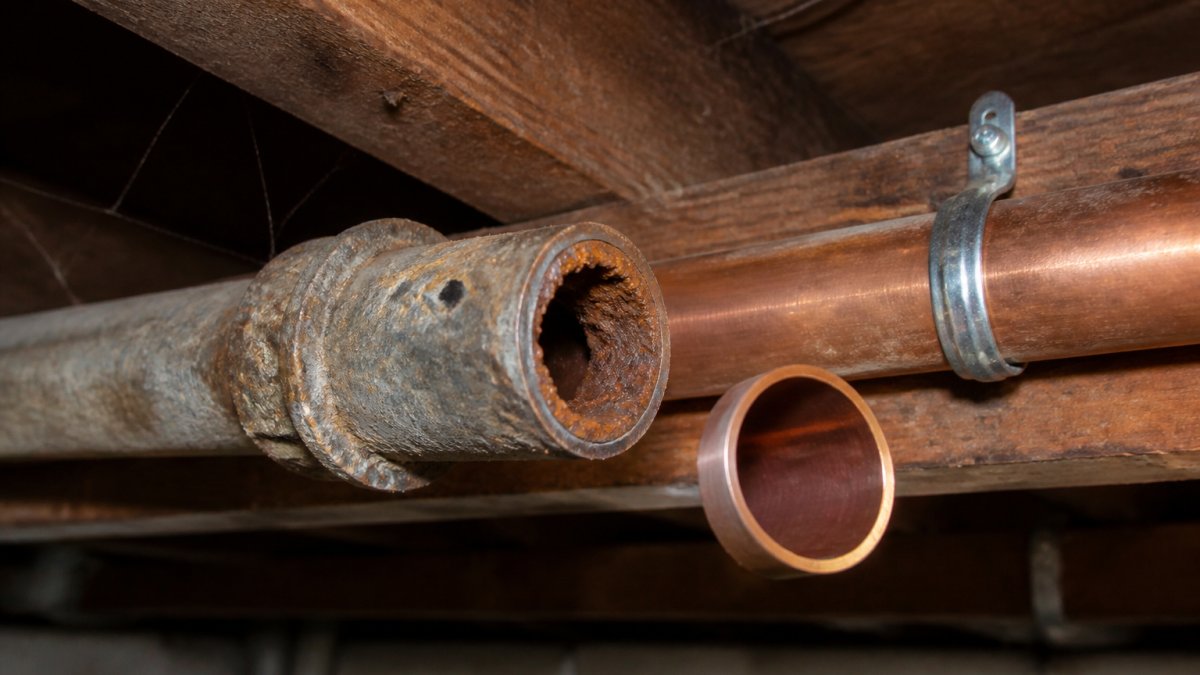
Rust buildup narrows the pipe from the inside. Water pressure drops, and the pipe can fail without warning. A pinhole leak behind a wall can soak insulation and framing for weeks before anyone notices.
2. Hidden Leaks in Supply Lines and Fixtures
Hidden leaks are the quietest of the common plumbing issues in older homes, and the most expensive. A slow drip inside a wall or under a slab causes water damage long before it reaches the floor.
In historic houses, hidden leaks cluster at predictable transition points. The most common is where a previous partial repipe tied new copper into the original galvanized steel. Dissimilar metals in contact with water create a galvanic reaction, and the joint corrodes from the inside.
Where we find them most:
- Under sinks, at the shutoff valve
- Behind toilets, at the supply line
- Inside walls where copper meets galvanized pipe
- Under slab foundations in post-war homes
- At lead wipe joints on pre-1940 supply runs
Thermal imaging finds these leaks fast. An infrared camera reads temperature differences on the wall surface, so a wet patch behind drywall shows up as a cool spot. InterNACHI on infrared thermography in home inspections explains how inspectors use this tool to spot moisture that the eye cannot see.
Symptom-to-urgency guide for hidden leaks:
| Symptom | Likely Source | Urgency |
|---|---|---|
| Musty smell in one room | Slow drip in wall cavity | Schedule within a week |
| Bubbling or peeling paint | Active leak behind the finish | Schedule within days |
| Water bill up 10-20% with no use change | Running leak somewhere unseen | Investigate now |
| Warm spot on the floor | Slab leak under finished flooring | Call today |
| Visible water stain spreading | Pressurized supply line failure | Shut off main, call now |
Watch for musty smells, bubbling paint, or a water bill that creeps up with no change in use. Any of those means a leak is running somewhere you cannot see.
On a historic home, chasing a hidden leak can mean opening original plaster, heart-pine flooring, or tile that cannot be matched. Ask the plumber to locate and mark the leak with the camera and moisture meter before any demolition, and to make the smallest access opening the repair allows. Patching plaster and refinishing old wood is a separate trade, and coordinating both up front usually saves the finish.
3. Clogged Drains and Slow Drainage
Slow drains in an old house usually point to the drain lines, not the fixture. Cast iron and clay drain pipes pit and scale over decades. Debris catches on that rough surface and builds up.
A common mistake is reaching for chemical drain cleaner first. It clears the visible clog but leaves the scaled pipe wall behind, so the drain clogs again within weeks.
Try this order instead:
- Pull the stopper and clear hair and soap scum by hand.
- Run a drain snake through the trap arm.
- If the whole house drains slow, call a plumber to camera the line.
When every drain in the house backs up at once, the blockage is in the main line. That is a sewer problem, not a sink problem.
4. Sewer Line Problems in Older Homes
Sewer line problems in older homes come from three sources: root intrusion, collapsed clay pipe, and bellies where the line sags. Clay tile was standard before plastic pipe took over, and clay joints separate as the ground shifts.
Chattanooga sits on heavy clay soil and sloping lots, and both put stress on old sewer laterals. Tree roots find the joints and grow into them.
Signs the sewer line is failing:
- Multiple slow drains at once
- Gurgling toilets after a shower or laundry cycle
- Sewage smell in the basement or yard
- Soft, sunken patches in the lawn
A sewer scope is the only way to know for sure. The camera shows the pipe material, the location of any break, and whether roots have entered.
Ask for the sewer scope recording, not just a summary. The video shows the exact distance to any defect, which matters when you negotiate repairs or plan a replacement.
5. Low Water Pressure from Aging Pipes
Low water pressure in an old home usually traces back to pipe condition, not the water supply. Rust and mineral scale narrow the inside of galvanized pipe until the flow chokes down.
Test it this way. Open a cold tap at the kitchen sink and a second one upstairs at the same time.
A more precise check uses a pressure gauge on a hose bibb. Static pressure should read in the 40-80 psi range on most municipal systems.
Other causes we check:
Schedule an Inspection or Request a Proposal →
- A failing pressure-reducing valve
- A partially closed main shutoff
- Mineral buildup in the water heater
- A clogged aerator or cartridge at a single fixture
- A gate valve that has stripped and is stuck half-open
Hard water speeds this up. Dissolved minerals settle out inside pipes and fixtures. A water softener slows the buildup but will not reverse damage already done.
Before authorizing a repipe, ask for a pressure reading at the meter and at the farthest fixture. If the drop between the two is small, the problem may be a single valve or fixture, and a full repipe is unnecessary. If the drop is large, the trunk line is the restriction, and a partial replacement of the worst run may restore pressure without opening every wall.
On a historic home, repiping raises a preservation question. Running new PEX or copper through original plaster walls means cutting access holes, and matching historic plaster and trim afterward is its own project. Some owners route new lines through basements, crawlspaces, and attics to limit interior demolition. Others accept a partial repipe of the worst branch and leave the rest of the original system in place, knowing the pressure will improve but not match a fully modern system. Either path is defensible; the decision should be made with the pressure readings in hand, not by default.
6. Outdated Fixtures and Failing Appliance Connections
Outdated fixtures and fittings cause a large share of the water damage we document. Old toilets run constantly. Worn faucet cartridges drip. Rubber washing machine hoses burst.
The running toilet is the one homeowners ignore. A flapper that does not seal wastes water every hour of every day, and the repair is a cheap part and ten minutes of work.
Check these connections each year:
- Washing machine hoses, replace rubber with braided steel
- Dishwasher supply line and drain
- Refrigerator ice maker line
- Water heater flex connectors
A burst supply line can release hundreds of gallons before anyone shuts the water off. Know where your main shutoff valve is, and test that it turns.
7. Water Heater Wear and Mineral Buildup
Water heater wear is the seventh of the 7 common plumbing issues in Chattanooga historic homes, and it is the easiest to prevent. Sediment settles on the tank bottom as hard water minerals drop out of the heated water.
That sediment layer does two things. It insulates the burner from the water, so the tank works harder. It also traps heat against the steel, which speeds corrosion from the inside.
Annual flushing drains the sediment before it hardens. Most manufacturers recommend it, and most homeowners skip it.
Watch for these signs of a tank near the end:
- Rumbling or popping sounds when it heats
- Rusty water from hot taps only
- Moisture or rust at the base
- Hot water that runs out faster than it used to
A tank that is leaking at the base cannot be repaired. Plan the replacement before it fails.
Old House Plumbing Types and How to Identify Them
Knowing old house plumbing types helps you read what you are looking at. The material tells you the age and the risk.
| Pipe Material | Typical Era | How to Identify | Main Risk |
|---|---|---|---|
| Galvanized steel | Pre-1960 | Gray, magnetic, threaded joints | Rust and internal scale |
| Copper | 1950-2000 | Reddish, soldered joints | Pinhole leaks in hard water |
| Lead | Pre-1940 | Soft, dull gray, easily scratched | Health hazard |
| Clay tile | Pre-1970 | Orange-brown, bell joints | Root intrusion and collapse |
| Cast iron | Pre-1975 | Dark, heavy, magnetic | Scale and cracking |
| PVC / ABS | 1970-present | White or black plastic | Joint separation |
Lead service lines deserve a hard look. If a scratch reveals shiny silver metal under a dull gray surface, stop and get the water tested. EPA guidance on lead in drinking water covers testing and replacement.
A plumbing inspection checklist for homebuyers should cover pipe material, water pressure at two fixtures at once, drain speed, the water heater age, and a sewer scope. That list catches most of what goes wrong in a historic house.
Pipe material is the single best predictor of plumbing risk in an old home. Identify it first, then test pressure, drains, and the sewer line in that order.
At Full Disclosure Property Inspection, we read every system in the house together, not in isolation. Our infrared thermal imaging is included free with fee-paid inspections, and it catches hidden leaks that a visual walkthrough misses. Melanie Crabtree is a Certified Master Inspector with more than 5,000 inspections behind her, plus a background in general contracting and land development. Tennessee home inspector licensing requirements set the standard we work to, and our reports spell out what actually matters versus what is minor.
Frequently Asked Questions
What type of plumbing in old houses can cause problems?
Galvanized steel pipes are the most common culprit in pre-1960 homes. They corrode from the inside, rust buildup narrows the water channel, and joints start to fail. Lead pipes also appear in some very old homes and should be identified early. Polybutylene supply lines, used from the late 1970s into the 1990s, are prone to sudden bursts. A plumbing inspection can identify which materials are present and flag the ones most likely to fail.
How can you tell if an older home has outdated plumbing?
Start with a visual check of exposed pipes in the basement, crawlspace, or attic. Galvanized pipes have a dull gray, threaded appearance and often show rust. Copper turns green or develops white mineral crusting at joints. Check under sinks for corroded shutoff valves and look at the water heater’s age sticker. Discolored water, low pressure, and frequent drain clogs are also signs of failing plumbing pipes. A professional plumbing inspection confirms what you cannot see inside walls.
Can old plumbing cause low water pressure or discolored water?
Yes. Rust and mineral buildup inside galvanized pipes narrows the interior diameter, which reduces flow to fixtures. Brown or yellow water, especially after a vacation when water sat in the pipes, points to internal corrosion. In homes with hard water, scale deposits add to the restriction. If pressure drops at multiple fixtures, the problem is usually in the supply lines rather than a single faucet. A plumbing inspection with thermal imaging can trace where the restriction is worst.
What should you do if an inspection finds a plumbing problem?
Get the scope in writing first. A report should state whether the issue is a repair, a partial replacement, or a full system concern. For active leaks or failing sewer lines, address them before closing or negotiate a credit. For older galvanized systems, ask a licensed plumber for a replacement estimate rather than patching section by section. If you are buying, a plumbing inspection checklist for homebuyers helps you separate urgent safety items from maintenance you can schedule later.
Old-house plumbing rarely fails all at once. It fails in the order the pipes were installed, and the warning signs sit in plain sight for years before the water hits the floor. Full Disclosure Property Inspection finds those signs before you close, with infrared thermal imaging included free, a detailed computer-generated report, and an independent opinion backed by a strict Code of Ethics. Schedule an Inspection or Request a Proposal and know exactly what you are buying.


